Football’s Own Country: Tracing Kerala’s World Cup Frenzy
As the 1986 FIFA World Cup was underway in Mexico, thousands of kilometres away in the southern Indian state of Kerala, V.V Damodaran Nair, a Hindi teacher at a government school in Pathanamthitta district was heading to the nearest city of Kochi. His purpose was to buy a television, a rare commodity in those times. The expensive product came at the cost of a college trip budget earmarked for his son. What was deemed a missed trip for the son turned out to be a boon for the villagers as they gathered at the verandah of Nair’s house, huddled around to watch live telecast of football world cup matches.
46 years later in the northern Kerala district of Calicut, at 1.00 am, Fousiya KP, along with her husband and children, head out of their home at midnight. They are hoping to find a seat at the big screen arena set up by a people's collective that can accommodate up to 300 people. Despite an unfavourable time zone, the crowd swelled to watch the Brazil versus Norway match at 1.30 AM on 6 July 2026. Men, women, and children gave up their sleep to cheer for their team and jeer at the rival team’s fans. Fousiya was unlucky as she had to settle for a place at the entrance where she stood on a two-wheeler vehicle to catch a glimpse of her favourite team.
“I grew up watching football matches with my family,” says Fousiya who identifies herself as a long-standing Brazil fan. “It doesn’t matter if they win or not, from my childhood I have always stood with Brazil,” she says with a sense of deep pride.
Vincent, an artist who lives 2 hours away from town, booked a hotel room near the screening arena in advance to watch the game with like-minded fans. “I can always watch it at home, but the joy and energy of watching it with other fans is unparalleled”, he says. But Vincent too was not lucky enough to find a seat, so he did what any ardent Brazil fan would do - immediately subscribed to the streaming service on his phone. He remained outside the make-shift gallery, watching the game on his phone and sharing the highs and lows of the game with the crowd. The game proved to be a nightmare for Fousiya and Vincent as Brazil crashed out in the round of 16, losing to Norway in a 2-1 game.
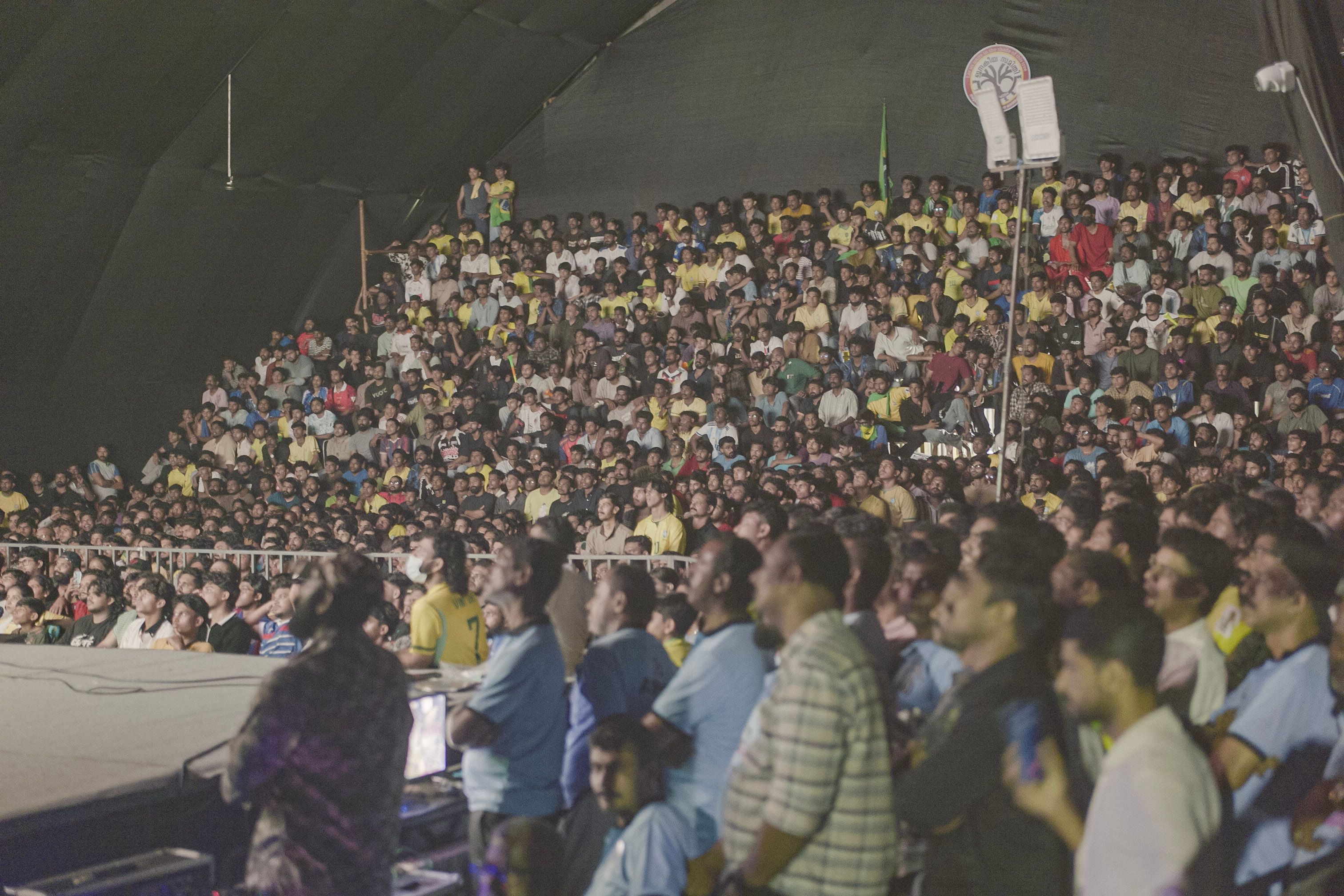
Fans gather at Puthiyapalam, Calicut at 3.30 am for a public screening.
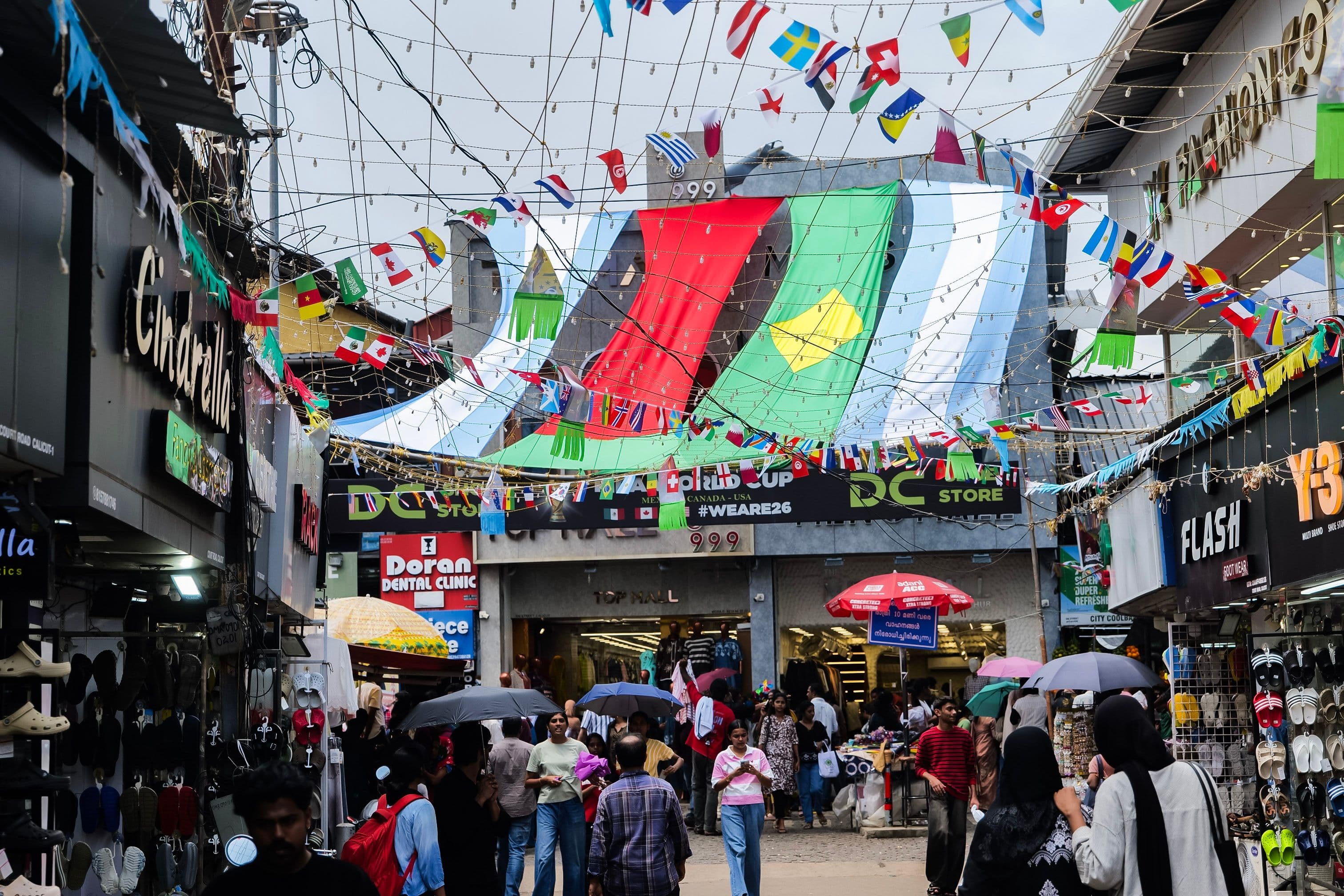
Nair’s and Fousiya’s stories are a reflection of the football frenzy that overpowers Kerala at the dawn of every FIFA World Cup. Emotions erupt in the form of fan-fights and giant cut-outs of favourite players. Emotions run high, joy is infectious, and the air is taut with rivalry. Away from the stunning stadiums, beaming floodlights, and roaring fans in USA and Mexico, across the Arabian sea, an emotive battle is fought in the coastal state of Kerala. In a land where football is religion and football stars are nothing short of godly figures, passionate fans are up for a month-long celebration and even sabbatical from work. Huge cutouts of Messi, Neymar and Ronaldo fight for space in the alleyways, paddy fields and riverfronts. Projectors and screens are booked in advance by local clubs. Fan groups battle out for dominance in the world of reels and likes. For the lovers of yellow and blue, it's a visual treat with walls, bus stops and clothes stores catching on the demand.
Kerala’s Football Legacy
Apart from their colonial past and socialist roots, there is one other commonality between Latin America and Kerala - both learned the game of football from their colonial masters.
“The introduction of football in Malabar, like elsewhere in India, was the by-product of colonial presence and the game was later appropriated by the native people”, writes Dr. Anas Ali, in a research paper titled ‘Football in Colonial Malabar: The Introduction of the "Beautiful Game”(1900-1940). “It was a site for claiming and sometimes about rejecting the hegemony (colonial) existed in the high politics of everyday life,” he writes, adding that the playground was a terrain which echoed the resonance of social cultural changes happening outside the field.
The locals of Malabar learned football by watching the members of the colonial Madras Special Police play. Geographically a gateway to the Indian subcontinent, interaction with the west made the game popular in Kerala. Soon they dominated the game, even beating their masters barefoot in local games. Players from Kerala soon became a norm in the Indian football team. In a state that tops in literacy, the locals, especially those in the northern Kerala districts grew closer to international football and stars through the newspaper, radio broadcasts, and later live telecast.
“Before TV, we used to listen to match developments through radio,” says Beena S Nair, a 59 year-old, retired school teacher from Pathanamitta district. In her youth, she followed detailed match developments through live radio commentary and the next day from local newspapers. The supporters of Maradona and Pele carved their own clubs-making a clear and natural binary when it comes to the FIFA world cup tournaments. As the generation shifted, Messi-Neymar-Ronaldo consumed popular fandom.
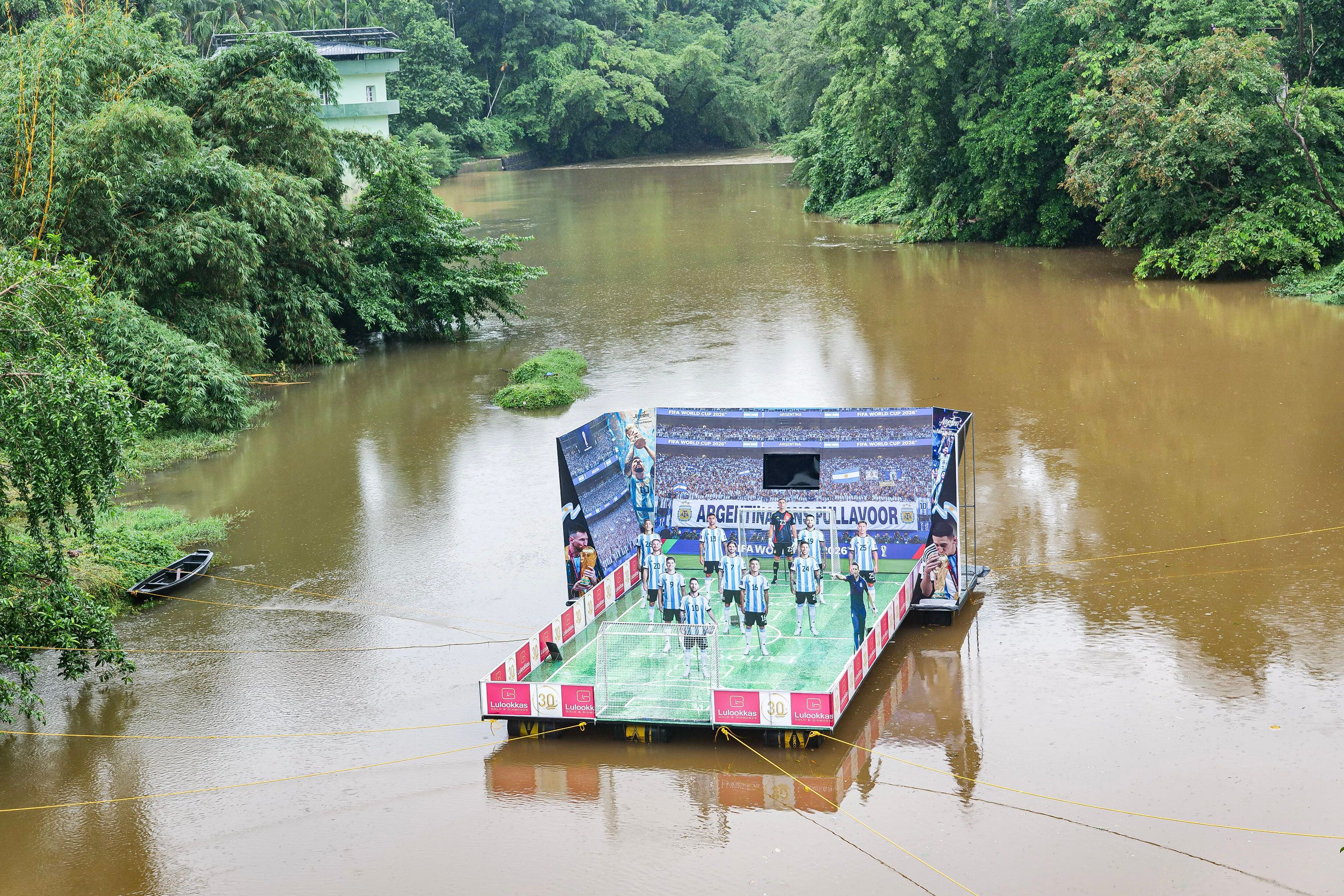
A miniature playing field consisting of Argentina team setup on a river in Pullavoor, Calicut
The Latin American nations have gripped the football lovers of the state like nothing other. Until recently the only communist-ruling state in India, Kerala had the first democratically elected communist government in the world in 1956. The Cuban revolutionaries of Fidel Castro and Che Guevara are household names, especially in northern Kerala-boasting of its strong and deeply spirited communist cadre. The news-hungry locals kept abreast of revolutionary struggles in Latin America, sympathizing and in solidarity with the working class struggles. The socio-cultural affinity with Latin America went hand-in-hand with the support for football. Each generation of footballers from Argentina and Brazil have made their own towering figures in Kerala.
Fan Stories
Subair Tharayil, a 49-year-old farm labourer from Vazhakkad village, Calicut has been a die-hard Argentina fan ever since he started following football at the age of 15. “In our locality, as children grow up, it is natural for them to pick a side; mostly Brazil or Argentina depending on the team preference of parents, neighbours and friends, “ says Subair who rose to social media fame in 2018 after his match analysis video-conveyed in an informal style, laced with a local slang, detailing the reasons behind Argentinian loss to France at the world cup went viral.
World Cup season is now a busy period for Suabir as local media channels land up at his Vazhakkad village house for game predictions and analysis which rake up large viewership online. Subair lives in a conspicuous house in the neighbourhood, painted with the theme of Argentina’s flag with a large football placed on the roof. The house was built by Argentina fans as a tribute to Subair’s long-standing support for the team after they lifted the World Cup in 2022.
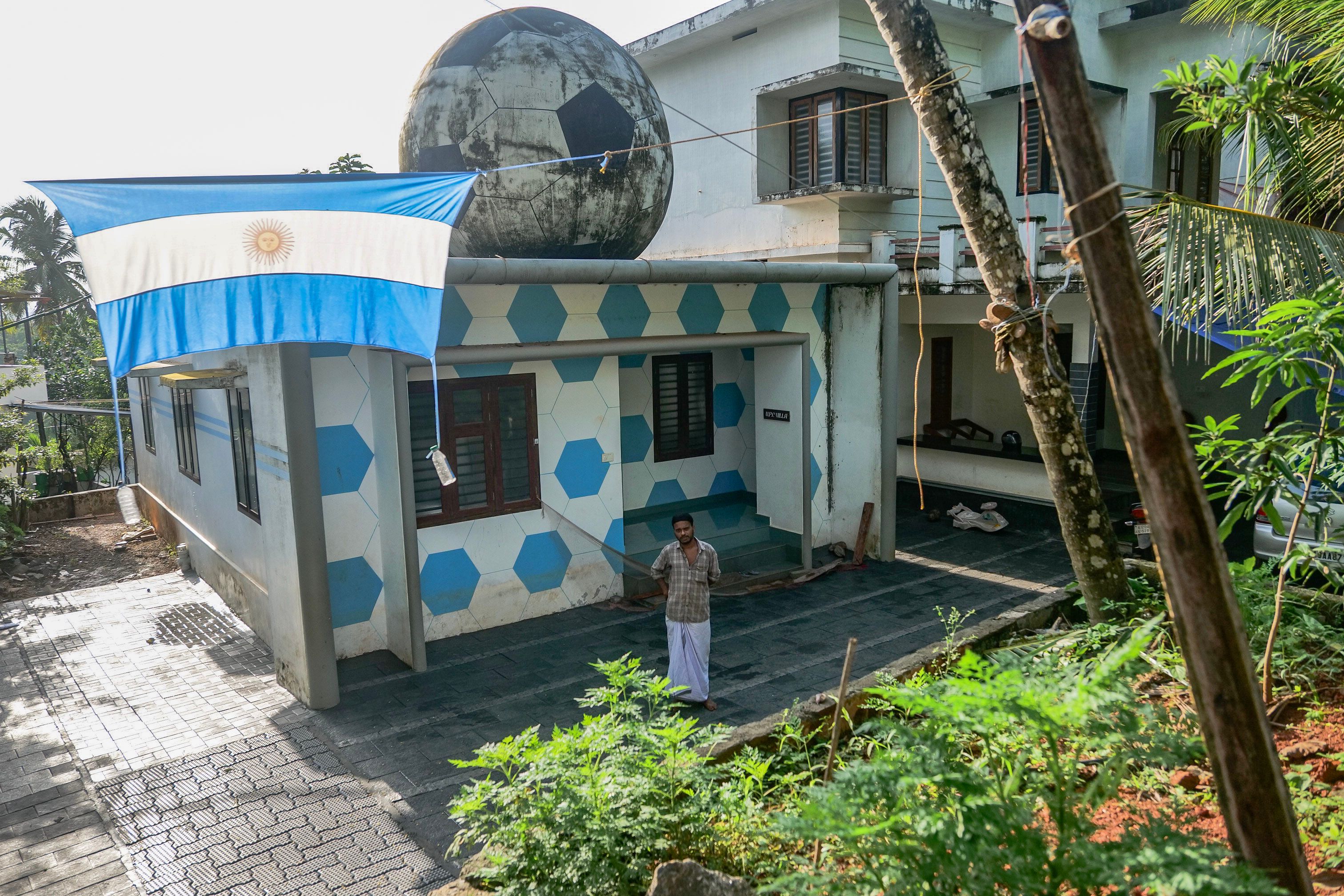
Subair Tharayil in front of his house at Vazhakkad village, Calicut
The 2022 Qatar World Cup was perhaps the most accessible host location for football fans from Kerala to watch the game live. Subair was offered free ticket and airfare by expatriate Argentina fans in the GCC but he was unable to travel as his sister fell sick. But he doesn’t regret his decision. “TV experience is in a way more superior as I am able to analyse each move up close, unlike in a stadium”, says Subair who has widened his geographical knowledge through world cup analysis.
‘For example, when I comment about the Curasoa team, I make sure to say they are from the Caribbean region,” says Subair whose worldview like many other Keralites is influenced by their passion for football.
Weeks before the first game, large cutouts, banners and posters appear in public spaces. Rural enclaves are often strictly segregated into patches blue and yellow. Even though one will find fans for almost all the teams vying for the cup, the favourites have always been Argentina and Brazil, followed by Portugal - largely because of Christiano Ronaldo’s fandom.
P. Shivadasan, President of ‘Puthiya Palam People’s Collective’ has been organising public screening for the last 3 world cups. Otherwise engaged in social works and charity activities such as helping the ill, when the world cup season kicks in, the collective is focused on public screenings and other arts and cultural events associated with it. “Football is in our blood. Many Indian players have emerged from our region. No other game can bring people together like football,” he says standing outside the public screening arena in Puthiya Palam with a capacity to seat 300 people.
Interestingly, the 2026 World Cup is the first one to take place after the reel boom. Through Instagram reels and YouTube shorts, fan clubs are waging a digital war to score points. Right from building huge cut-outs of favourite players to the experience of watching the match, each development is captured and aired on social media. Existing influencers make a merry and new ones emerge out of the shadows to capitalise the football season to gain followers and increase viewership.
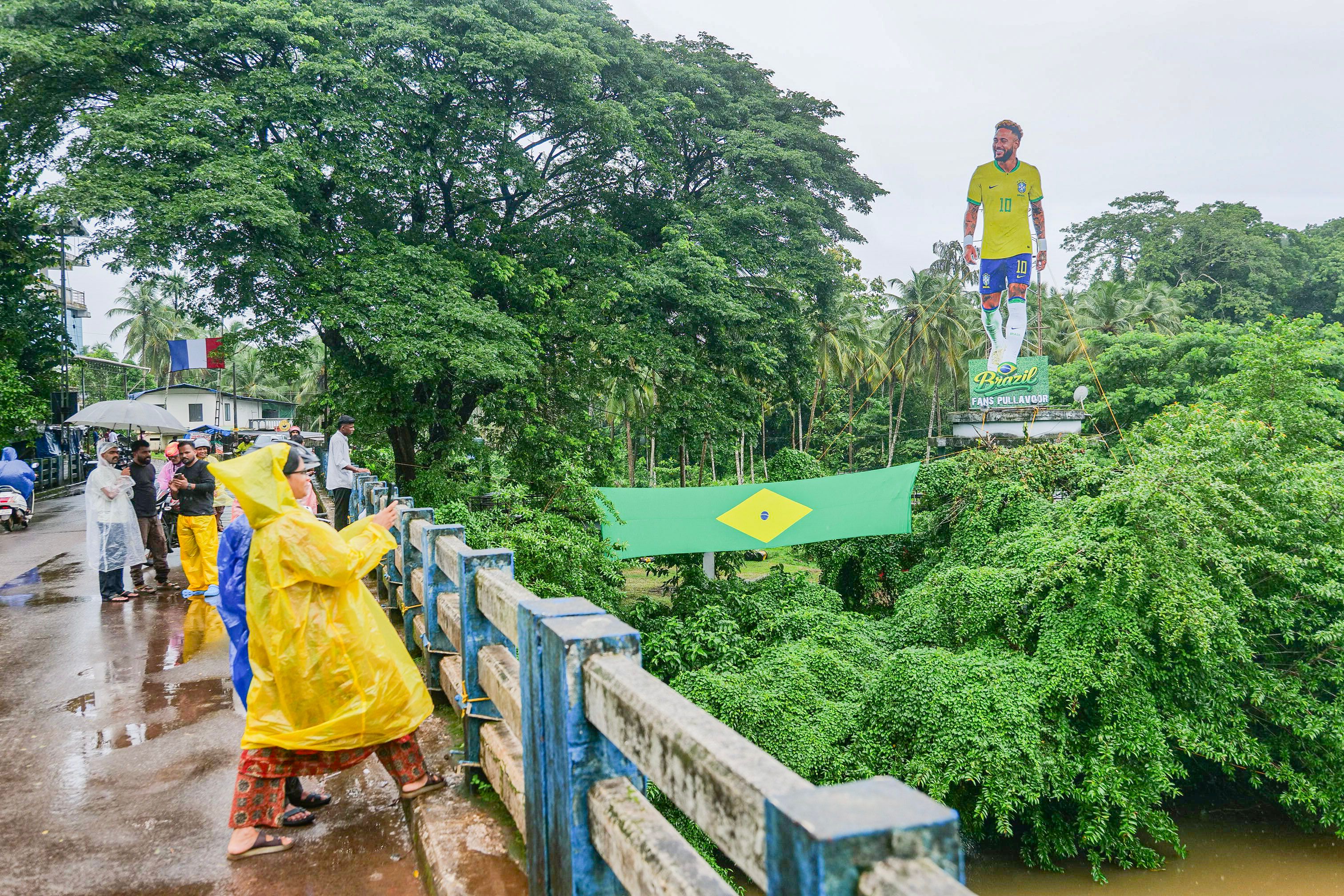
A woman clicks a picture of a Neymar cutout from a bridge in Pullavoor, Calicut
What is unique about football is that in a place divided along political and (off late) religious lines, the game often unites people and brings foes together. From the weary working-class housewife to the enthusiastic school-going boy, the world cup is a time of adrenaline rush for people cutting across age, gender and class.
Merchandise
For the fans, the affection for the game finds expression in jerseys, flags, hoardings, and cutouts. The month-long fest is a bonanza for the supply chain - from the jersey manufacturers in Thiruppur to retail sellers across the state, the season brims with activity.
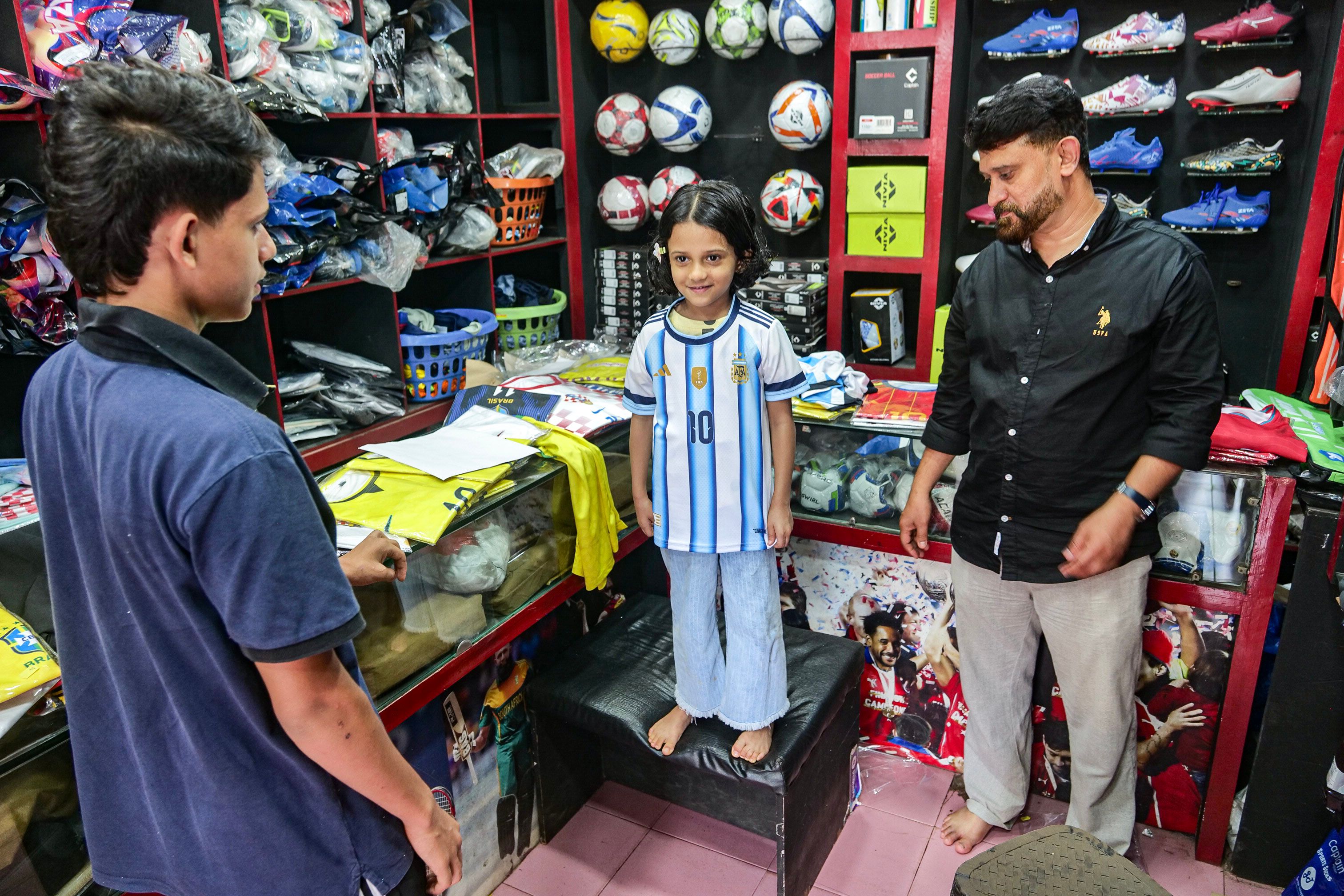
A child tries on a Messi jersey at a sports store in Mavoor, Calicut
“We are unable to meet the demand for team jerseys,” says Nishad Mavoor, who runs a sports store in Mavoor, Calicut. He says this world cup season, the sale at his store is 60-70% more than the usual monthly average with demand soaring for Messi’s jersey followed by Christiano Ronaldo and Neymar.
When we visited his store, the jersey stock’s rack was fast being emptied as children accompanied by parents made a beeline to buy their favourites. As part of the anti-drug campaign, schools in the neighbourhood have asked students to wear their favourite player’s jersey for a weekly event where students would perform a dance or a song on stage. “Such content would eventually go live as reels and motivates more schools to adopt the same practice”, says Nishad who had played for Kerala state in the under 21 category.
Legacy of Sevens Footbal
After his stint with Kerala team, Nishad now plays for Sevens Football tournaments. In North Kerala, football frenzy is not just a once-in-four-years affair. Every year after monsoon, preparations would be underway for the Sevens Football League. Played in smaller grounds with seven players in each team, the localised tournaments attract large crowds. Organisers build large arenas and entry is ticketed. Players from certain African nations often land up in northern Kerala for the sevens season and eventually become familiar figures with huge fandom. Played under flood lights and starting from October, each team can accommodate 3 foreign players. Local sponsors and cash prizes make this a fairly profitable affair for the organisers. The acclaimed Malayalam film ‘Sudani From Nigeria’, is premised on Kerala’s unique Sevens culture. The film captures the emotional bonding story of a Sudanese player and his local Kerala manager.
The World Cup season comes to an end on July 19th. Brazil and Portugal, two teams with massive fan following, are already out of the running and disappointed fans have made their grief public on social media. On the other hand, Argentina fans are still hopeful that Messy will lift the cup one more time on what might be his last dance.
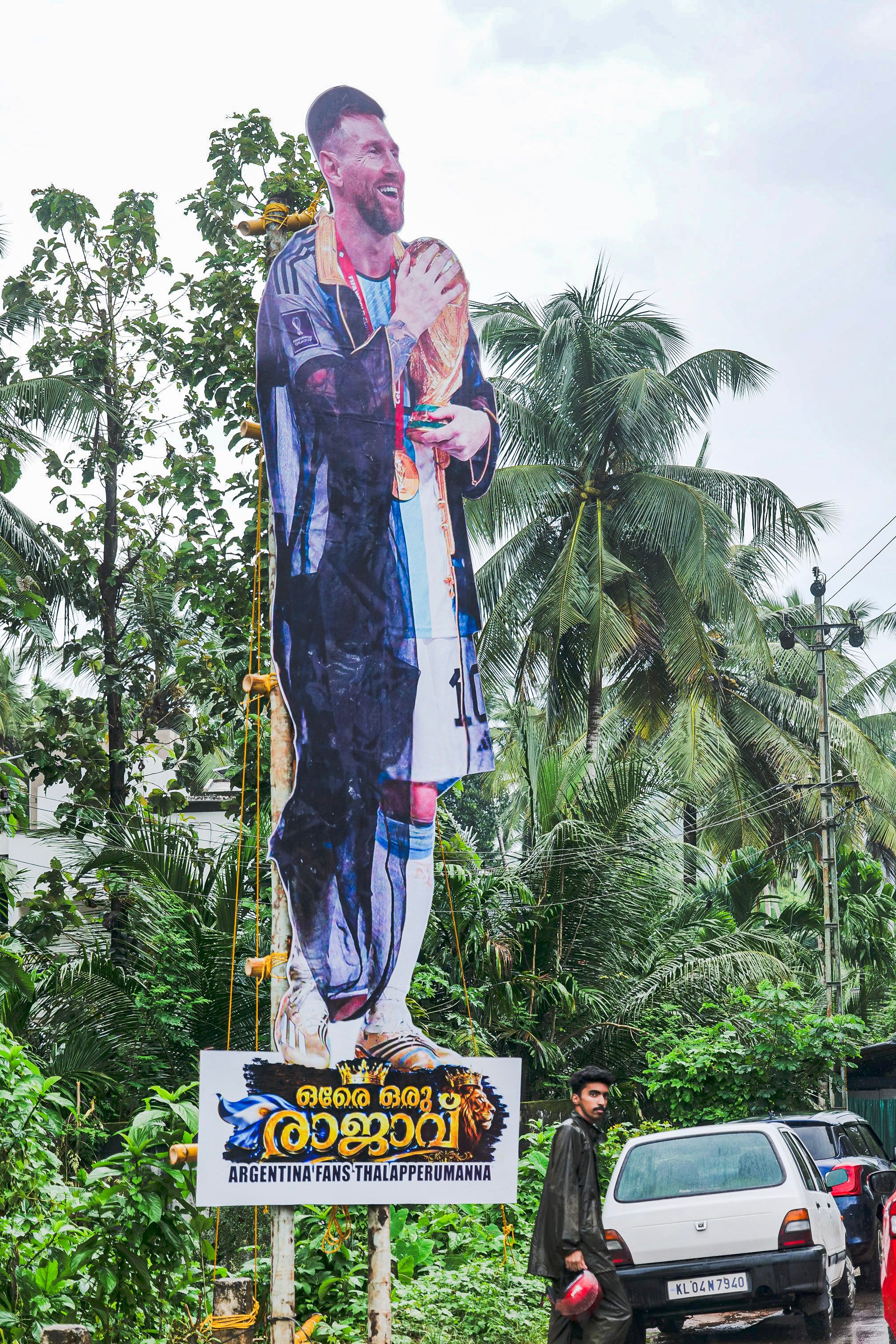
A large cutout of Messi in Pullavoor, Calicut
India’s absence from the World Cup has been a lingering concern for fans and lovers of the game. Even with FIFA expanding the tournament to include 48 teams, a nation of over 1.4 billion could not make it anywhere near qualification. With teams such as Curacao and Cape Verde making an impact this world cup, it could be a wake up call for India to pull up the socks and set in motion a process wherein young talents are identified, trained, and made competent to build a strong national team behind whom the coming generation of fans could rally.
-End-